Imperative Polarities
Imperative Polarities Title

Introduction

This project addresses the hypothetical connection between the left brain’s tendency toward processing logic and the right brain’s tendency toward understanding creativity.

These different processes relate to, and have ultimately have made it possible for me to connect outsider art to my major of web design, in a way that has become imperative to perpetuate the creativity, organization, and quality of my work.

Inspiration

Also known as brain lateralization, what led me to this initial interest was researching Alex Grey and his interest in polarities (yin and yang, day and night, masculine and feminine, left brain and right brain).

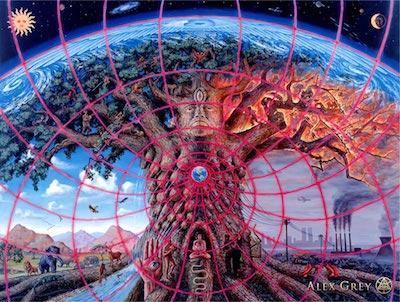
His art is a beautiful culmination of the left brain’s understanding of science/anatomy/organization and the right brain’s appreciation for spirituality/art/beauty.

Gaia by Alex Grey

Title: Gaia

Artist: Alex Grey

Year: 1989

Medium: Oil on Linen

Traditionally

According to traditional psychology, people who are “left brained” are often said to be more logical, analytical, and objective.

Also according to traditional psychology, people who are “right brained” tend to be more intuitive, thoughtful, and subjective.

Logic Language Critical Thinking Numbers Reasoning
Recognizing Faces Color Creativity Intuition Music Images

Functions

Speech and language, logical analysis and reasoning, mathematical computations

Spatial awareness, intuition, facial recognition, visual imagery, music awareness, art, rhythm

Traits

Linear thinking, sequential processing, logical decision-making, reality-oriented

Holistic thinking, random processing, intuitive decision-making, non-verbal processing, fantasy-oriented

Perceived Personality Traits

Analytical, logical, pay attention to detail

Creative, artistic, open-minded

Overall Thinking

Linear, detail-oriented - "details to whole" approach

Holistic, big-picture oriented - "whole to details" approach

Thought Process

Sequential; verbal (process with words)

Random; non-verbal (process with visuals)

Problem Solving

Logical - order/pattern perception; emphasis on strategies

Intuitive - spatial/abstract perception; emphasis on possibilities

Strengths

Mathematics, analytics, reading, spelling, writing, sequencing, verbal and written language

Multi-dimensional thinking, art, music, drawing, athletics, coordination, repairs, remembers faces, places, events

Difficulties

Visualization, spatial/abstract thinking

Following by sequence, understanding parts, organizing a large body of information, remembering names

When Damaged

Trouble speaking or understanding spoken or written words; slow, careful movements; inability to see things on the right side of the body

Trouble with visual perception (understanding how far or near something is); neglect of left side of the body; inability to see things to the left; poor decision making; impulsiveness; short attention span; slow learning of new things

Metaphorically

Correlation

This interest in the necessary opposites that are manifested through right brain and left brain is why I came to the Art Institute to learn web design. More specifically, I wanted to involve and educate my left brain’s sense of code/logic and my right brain’s sense of design/art.

This fundamental culmination of forces that are opposite but each necessary for the success of the other is something that I’ve always found very interesting. In researching educational opportunities for myself, I found that other colleges had either a computer science program geared toward IT positions (left brain), or a graphic design program emphasizing craft through cutting pieces of paper and rubber cement without even touching computers (right brain). While both of these extremes are undoubtedly useful for their different respective applications, I wanted a hybrid that was a happy medium between these opposite ends of the spectrum, utilizing both sides of the brain, and I have mostly found that in the web design program at AI.

Google DeepDream

Google’s DeepDream is basically a computer vision program created by Google which uses what’s called a “convolutional neural network” to find and enhance patterns in its vast and continuously growing library of images. It does this via something called algorithmic pareidolia, meaning it takes the human tendency to see a familiar pattern of something where none actually exists (i.e. the man on the moon, animals in cloud formations, etc.) and it catalogs these patterns over and over again, building on layers of enhancement, creating some combination of a trippy, dreamlike, hallucinogenic, and/or sometimes terrifying appearance in the deliberately over-processed images. To really appreciate the enormity of its excellence, it is necessary to see an image before being processed by DeepDream and after.
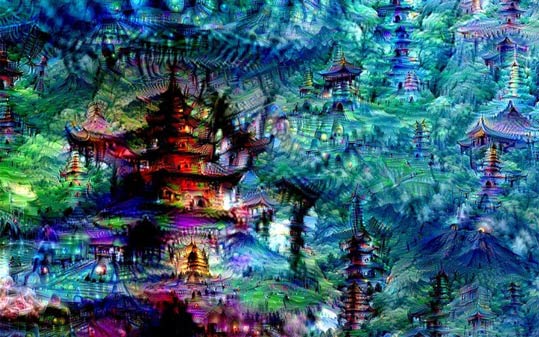
Google Deep Dream Example

Although the images generated by DeepDream are undoubtedly mind-blowing, we actually understand “surprisingly little” of how it actually works. According to the creator of DeepDream, “we simply feed the network an arbitrary image or photo and let the network analyze the picture. We then pick a layer and ask the network to enhance whatever it detected.”

Recently, there was an entire exhibition of art generated or enhanced by artificial intelligence programs held in San Francisco’s mission district, co-hosted by Google and the Gray Area Foundation. When addressing the crowd at this event, due to the slightly controversial nature of whether or not this is art, a Google machine-intelligence developer named Blaise Agϋera y Arcas “likened the artistic use of such programs to photography, or the employment of optical instruments by Renaissance artists – tools which may have had their detractors, yet are now an accepted part of art history.”
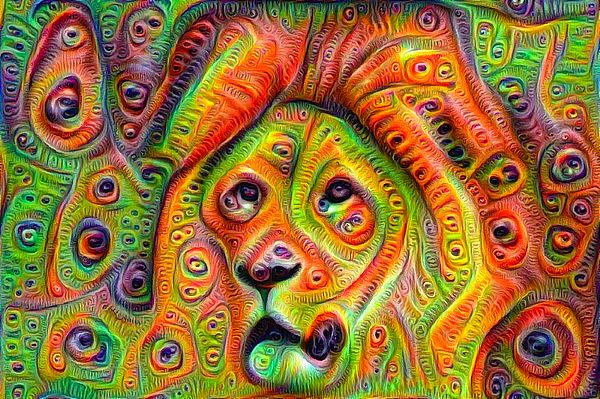

Google Deep Dream Example Google Deep Dream Example

The whole concept of determining whether or not a piece is “art” reminds me of Marcel Duchamp and the concept of the readymade, where the idea of “what is art” became almost more of an intellectual pursuit than an aesthetic one. Despite all the debate, Duchamp is undeniably considered to be an integral part of art history. Similarly, Blaise Agϋera y Arcas mentions that Google’s DeepDream is “re-inscribing what it means for something to be called fine art, what counts as skill or creativity, what is natural and what is artifice, and what it means for us to be privileged as uniquely human”. Despite the controversy, kind of like Duchamp, it is without a doubt that art generated by artificial intelligence such as DeepDream will have some kind of profound effect on art and its trajectory in history that people will eventually study.

HTML5 Canvas

Looking into more artistic ways to pursue web design as a result of being inspired by outsider art, I came across a relatively new HTML element called canvas. It is used to draw graphics on the fly via scripting (usually JavaScript), and it can be either generated without any user input, or generated as a result of the user clicking or moving the mouse, or even inputting information via the keyboard.

This is something that I would like to further explore, because especially as a front-end web developer, I would like to be able to give myself an edge in the graphics department to really give my work that “wow” factor. There are more and more beautiful examples of canvas being used online, and they can really be true works of art, almost like a modern web version of outsider art. There is such an enormous variety of artistic things that can be done using this tool, and 21 of the best examples on the internet were collected by a code enthusiast and published in an article (Sharma). This is one of my favorite examples, and it really has to be experienced interactively to be truly appreciated.

Realistically

History

“Pop psychology” has popularized the whole theory of lateralization of brain function being very specific, with the brain containing two hemispheres that each perform a their own typical set of functions, relatively independently of each other. This became a popularly held belief for a few decades as a result of the research of Nobel Prize winner Roger W. Sperry. While studying the effects of epilepsy, Sperry discovered that cutting the corpus callosum in epileptic patients could reduce or eliminate seizures. In addition to helping the seizures, however, many “split brain patients found themselves unable to name objects that were processed by the right side of the brain but were able to name objects that were processed by the left-side of the brain.” Based on these results, Sperry determined that language was controlled by the left hemisphere of the brain. This mushroomed into the other popular theories about the right brain being more creative and the left brain being more analytical, and that people either think one way or the other.

Show more

It's Basically a Myth

Upon further research, specifically with one groundbreaking study published at the University of Utah in 2013, the sense of separation between brain hemispheres is only true to a certain extent, and not in the way that has been widely believed for so long. According to the lead author of the study, Jeff Anderson M.D. Ph.D., “It’s absolutely true that some brain functions occur in one or the other side of the brain. Language tends to be on the left, attention more on the right. But people don’t tend to have a stronger left- or right-sided brain network. It seems to be determined more connection by connection.” So while there is a limited amount of truth to Sperry’s findings, the hemispheres don’t work at all independently as was once believed. In fact, a graduate student in neuroscience who carried out the study as part of his coursework named Jared Nielsen said that “we just don't see patterns where the whole left-brain network is more connected or the whole right-brain network is more connected in some people”. Science writer Carl Zimmer put it beautifully by saying, “The pop psychology notion of a left brain and a right brain doesn’t capture their intimate working relationship.” More specifically, in terms of the classic question of language and if it is or isn’t processed on the left side, “the left hemisphere specializes in picking out the sounds that form words and working out the syntax of the phrase, for example, but it does not have a monopoly on language processing. The right hemisphere is more sensitive to the emotional features of language, tuning-in to the slow rhythms of speech that carry intonation and stress.”

Show more

But Still Relevant

Despite the fact that the typically held theory of brain lateralization has been basically proven to be more false than true, people in different industries like accounting, real estate, or even web design (probably not anyone in the neuroscience field) have still continued to utilize this “left-brain/right-brain” way of thinking as an unscientifically backed but definitely useful construct for discussion. Looking at it from a web design and development perspective, while the right side is obviously useful for creating visually compelling pieces, the left side is equally necessary to actually make these artistic ideas come to fruition. When you think about it, every design and coding challenge can be looked at as “a problem to be worked out, or a puzzle to be solved.” And if you approach it like that, then suddenly both sides of the brain become extremely important because solving web problems can be so multifaceted that it’s necessary for the two hemispheres to work totally in conjunction with each other. Joshua Johnson put it beautifully by saying, “creativity can be chaos, analytical problem solving can be boring, it’s when they come together that great design truly takes place.” And whether or not the traditionally held theory of left-brain/right-brain has been debunked, I think this basic concept does hold true when it comes to web design and development. Either way, I’m running with it.

Show more